At lunch we reached the town of Kerak, dominated by a crusader castle. We found our way up through narrow streets, then crossed a deep moat to get into the castle. 
The stone-clad glacis was a formidable defense. The idea of climbing this while being bathed in hot oil was not attractive. Within the castle, there were buildings that had suffered the ravages of time and battle - this church still stood, some 800 years since it was last used:
which was amazing when one thought of the earthquakes to which this region is prone. When you went deeper into the castle, you found even more remarkable structures. Under the church, for instance, was a mosque, built by the muslim conquerors:

Deeper still, there were wide, dark passageways leading to rooms lit by narrow slit windows that looked down, down down into the valley far below:

There was even a kitchen, with ovens and millstones and washing places, dusty but proably still functional if cleaned up. They used to feed over 2000 when under siege, as the Crusaders occasionally were.
 Leaving the castle, we threaded our way through a maze of one-way streets in the town, and finally dropped into the valley leading to the shores of the Dead Sea. A wonderful road led along the eastern margin, carved into the cliffs in places. At one point, Mrs Lot, all of 30m tall, towered above us:
 On the brim of the Dead Sea, a rime of white salt several meters high showed how the level was dropping:
Jordan, Palestine and Israel are tapping the fresh-water streams that feed into the Sea, and it is slowly becoming saltier and saltier.
Further up the coast we came to Sulimeyeh, a resort on the edge of the Dead Sea. We stayed in a fantasy hotel, with an "Arab village" theme of walkways and small courtyards, many with cooling fountains tinkling in their midst:
 Down at the edge of the sea was a picture-postcard pool, with a view over the Sea to the Israeli shores on the West Bank:
We felt we deserved a night of luxury after the donkeys of Petra!


 Some of it was on a very human scale, small memorials to lesser men, now wearing a little thin and showing signs of age.


 There followed a long slog down the old Roman road, through Roman ruins being restored, accompanied by a marvellously persistent couple of local children leading a pair of donkeys. Why were we walking? - We could ride! It was very hot, and at the bottom of the valley there was a cool cafe and a chance to have something to drink and admire the museum. Then to brave the climb up 600 steps to the Monastery.
 The scale beggars description. Suffice it to say that the step up to the door is 2m high, and the white blob at the bottom left of the doorway is in fact a reclining figure, exhausted from the scramble up! One had to wonder what had moved people to carve such a monument on such a scale so high on a remote mountain.

 Strictly speaking, it was the Crusader castle of Mons Realis or "Montreal." Much of the top was in a state of ruination, with the great spherical boulders catapulted there during a siege to show why it was in such a bad shape. Best preserved was the North-West watchtower, reconstructed by the Arabs in the 13th Cent after they had destroyed the original while capturing the castle.


 The chamber inside the Treasury was devoid of objects or decoration - but the natural decoration on the roof and walls fully made up for the lack!
  It was getting late. The camels were being gathered before being taken home. We would head up the narrow crack opposite, the entrance to the Siq, and head back to our hotel to return the next day.
 Then into the Hippodrome, where even today there are chariot races. This is a view from the race track back towards the starting gates:

 The hill on the left leads up past a great temple to a theatre from which came the unlikely sound of bagpipes. It was a local, uncannily clad in a kilt, welcoming visitors to his stage!
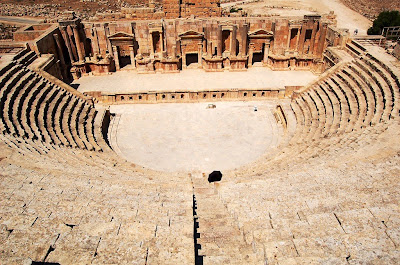 The black splodge in the centre is the Traveller, hiding her fevered brow under a black umbrella. It was extremely hot.
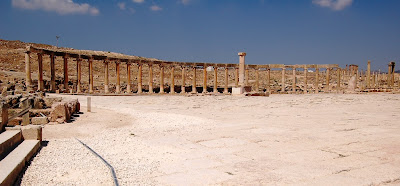
 Looking down from the top row of the theatre, below was the circular forum and the great main street stretching out for several kilometers, lined by pillars, with modern Jarash in the background.
 And, of course, there were marvellous temples where the faithful could go to worship Artemis, because Christianity had not yet reached the town.
 It was therefore a surprise to find, in the museum on our way out of the site, a gravestone in the form of a cross. The date, which translated to 26BC, reminded us that Christian symbolism had a pre-Christian ancestory.
